As part of our sustainability strategy, we focus on four areas of action, each with its own key themes.
In 2024, we also introduced our group-wide Fuchs Group Standard, which makes a significant contribution to the further development of our international sustainability management. Depending on the number of employees, different standards apply to our subsidiaries, which must be implemented on a mandatory basis in the coming years. These include, amongst others, standards such as the SMETA audit, ISO 45001 and ISO 14001.
Translated with DeepL.com (free version)
Most of the raw materials for our products are grown in distant countries outside Europe, as these are the places where the necessary climatic conditions for their cultivation exist. Given the diversity of our raw materials, this results in a complex sourcing strategy. We are committed to gradually improving transparency and traceability in our supply chains, for example through the implementation of a Code of Conduct and the further development of our risk management system. After all, the foundation for the quality of our products is laid at the cultivation stage. Quality assurance and management are therefore key elements throughout our value chain.
We offer our customers and consumers a unique range of spices, herbs and other flavourings. Transparency regarding ingredients is just as important to us as further improving the recyclability of our packaging and increasing the proportion of recycled materials it contains. In doing so, we are guided by the requirements of the PPWR and are working to meet them step by step.
People are at the heart of our success! We aim to be an attractive employer for our staff, offering them working conditions in which they can fully realise their skills, potential and motivation to work and develop, whilst ensuring that their health is protected and promoted.
For us as a spice manufacturer, a healthy environment is of particular importance, as many of our raw materials can only grow under specific climatic conditions. That is why we attach great importance to using resources such as water and energy responsibly. We are therefore working on various levels to cut consumption and reduce waste in the production process.
The Fuchs Gruppe’s total emissions for the 2024 financial year amount to 707,888 tCO₂eq. The emissions are accounted for in accordance with the GHG Protocol.
96.6% of our emissions fall under Scope 3, i.e. along our value chain. The remaining 3.4% are attributable to Scopes 1 and 2.
At the end of 2023, we committed to the Science Based Targets (SBT). At the end of 2025, our targets were validated by the SBTi.
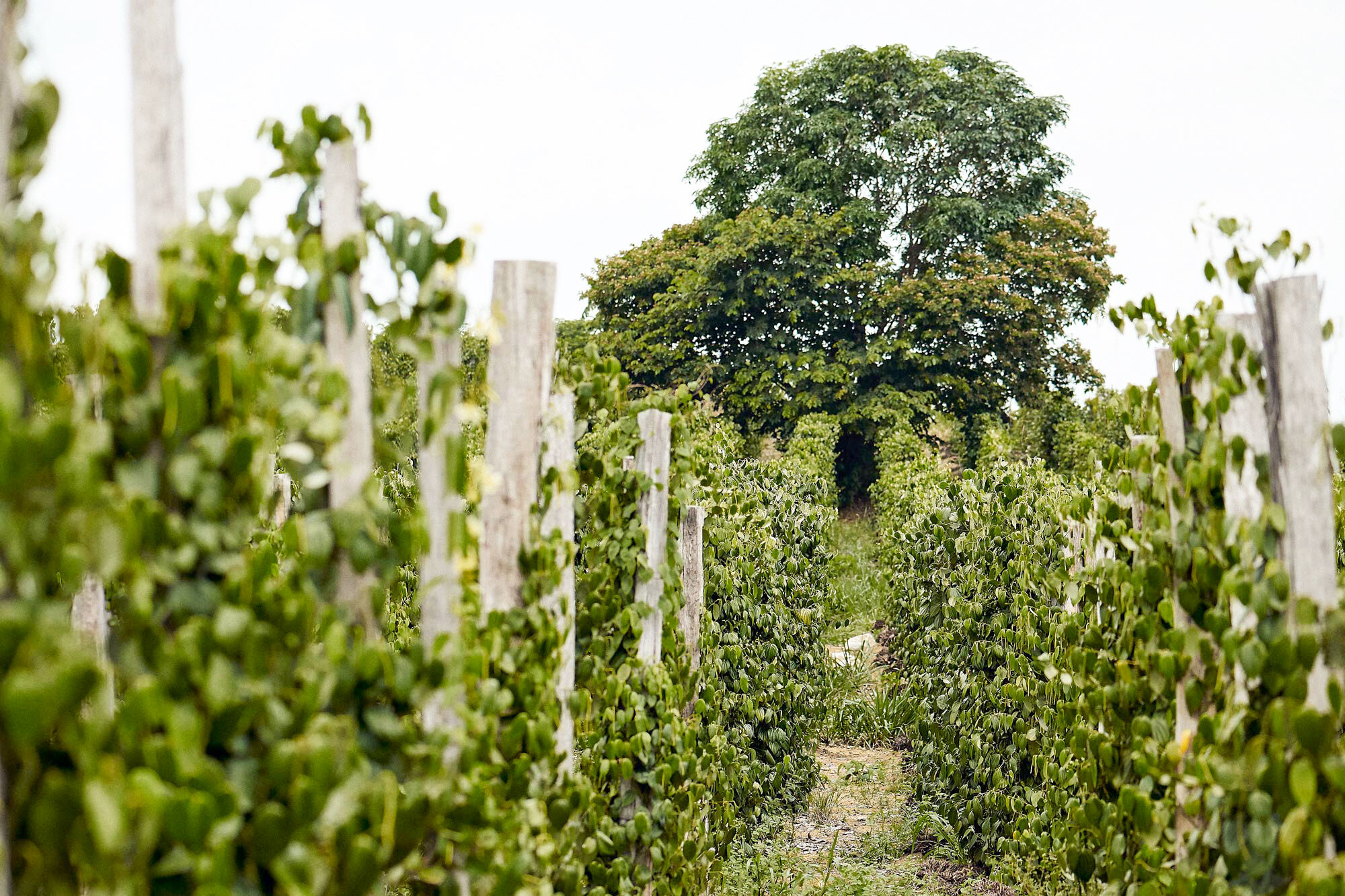
For the pepper supplied by our Brazilian subsidiary Tropoc, we have calculated the Product Carbon Footprint (PCF) in accordance with the GHG Protocol (internal calculation, cradle-to-farm gate, 2025). In this calculation, the use of the Gliricidia plant as a trellis support was compared with that of wooden stakes. In the calculation, wooden stakes were found to have a carbon intensity that was around 14 per cent higher.
In collaboration with the Scharlaug Agricultural and Forestry Enterprise, we began work in 2024 to convert a 3,780 m² area of sparse woodland into a climate-resilient forest. Based on a forestry report featuring a comprehensive site analysis, a structurally rich mixed forest comprising tree species suited to the site and rich in deciduous trees is gradually being established here. In total, over 600 young trees have been planted, which will sequester around 385 tonnes of CO₂ in the long term whilst also enhancing the forest’s biodiversity and ecological stability.
Since autumn 2025, we have been a Climate Forest Sponsor for a second area. Across 16,758 m², an existing pine monoculture is being gradually converted into a stable, climate-adapted mixed forest. Both projects are designed to involve 20 years of active forest conversion and are secured for the long term by an entry in the land register.
Project update: Climate Forest Sponsorships in Mecklenburg-Western Pomerania – Fuchs Gruppe x Scharlaug
Since 2023, we have been working alongside Woord en Daad, Nedspice and Job Booster India to support turmeric farmers in Andhra Pradesh. The focus is on Good Agricultural Practices (GAP), strengthening Farmer Producer Organisations (FPOs) and actively involving women in agricultural decision-making processes. In 2025, we visited the site ourselves and, together with the project team, gained a comprehensive understanding of how the project was being implemented. Internally, we have further developed our due diligence processes. Meanwhile, our project partners have been conducting training sessions on sustainable farming methods, integrated pest management (IPM) and quality standards. They are also empowering women’s groups and supporting the farmers through regular field visits. In the second quarter of 2026, we will conclude three years of intensive collaboration.
Since 2024, we have been holding our Sustainability Weeks every year at our international sites. During these two weeks, many colleagues around the world get involved in a variety of projects. From tree-planting initiatives to cookery classes and recycling projects – the activities are wide-ranging.
You are currently viewing a placeholder content from Vimeo. To access the actual content, click the button below. Please note that doing so will share data with third-party providers.
More InformationYou are currently viewing a placeholder content from YouTube. To access the actual content, click the button below. Please note that doing so will share data with third-party providers.
More InformationYou need to load content from reCAPTCHA to submit the form. Please note that doing so will share data with third-party providers.
More Information